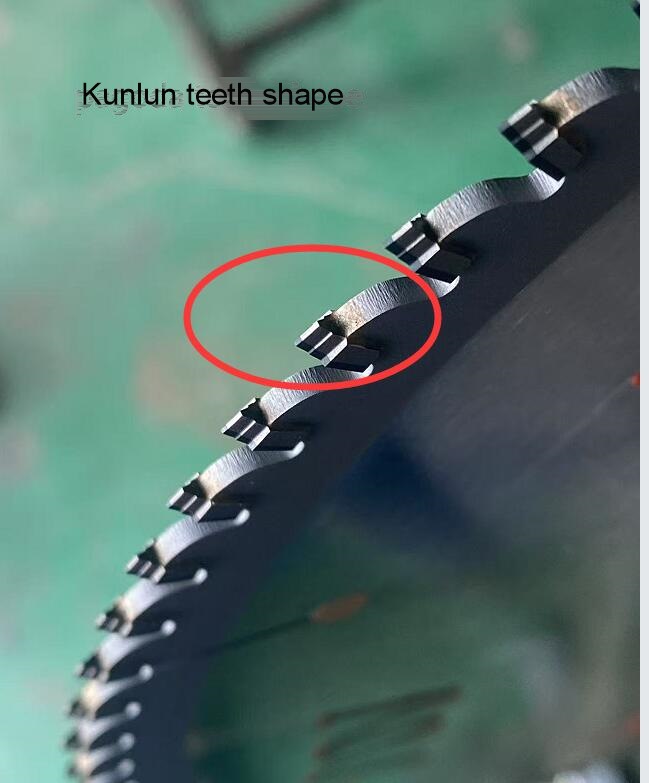
Kunlun Teeth
Kunlun Teeth PCD Saw Blade: Panel Cutting Without Scoring
What the Kunlun teeth shape is, which panels and machines it suits, where it is the wrong blade, and the six details that fix a PCD blade specification.

The Kunlun teeth shape is a conical, stepped PCD tooth profile for panel and woodworking saw blades. Instead of scoring the underside first, one blade trims both faces as it cuts, so the exposed edge leaves the machine without the chipping, burrs and notch tearing that a plain tooth profile leaves behind. It suits furniture and panel plants cutting melamine-faced chipboard, MDF, HPL, veneer and painted board on track saws, panel saws, vertical panel saws and sizing lines. It is not the right blade for reclaimed timber that may hold nails or stone, for rough sizing, or for any cut where the blade is likely to be abused - those jobs stay on carbide or tool steel. This guide covers what the profile is, where it fits, where it does not, and the six details that fix a specification.
What the Kunlun teeth shape actually is
Most saw teeth are ground around one job: clearing chips fast. The Kunlun profile adds a second job - controlling the surface the tooth leaves behind. Its conical, stepped geometry supports the panel as the tooth enters and leaves the cut, so the decorative face and the core edge are trimmed in the same pass instead of being pre-scored from underneath.
In practice, one blade performs the preliminary trimming that a scoring saw would normally do. The point is not that the blade is sharper. It is that the cut line is supported on both faces while the tooth is in the material, which is what limits fibre tearing at the edge.
One blade, no scoring unit - and both faces leave the machine ready for edge banding or assembly.
Where the blade fits
Panels
Melamine-faced chipboard, MDF, plywood, OSB, HPL and compact laminate, veneered board, painted and lacquered panels, acrylic and some composite sheets. The common thread is a decorative or finished face that cannot be sanded after cutting.
Machines
Track saws and portable saws at 160 mm and 168 mm with 20 mm bores. Panel saws and vertical panel saws at 205 mm and 230 mm with 25.4 mm bores. Multi-blade sizing lines and larger panel saws at 250 mm with 30 mm bores. Diameter and bore come from the machine; tooth count follows from the panel mix and the edge standard.
Single- and double-sided work
The profile is specified for single-sided and double-sided panel cutting. On double-sided laminated work it replaces the scoring-then-cut sequence; on single-sided work it removes the need for a sacrificial backer board in most setups.
Where it is the wrong blade
PCD is expensive, and there are jobs where its hardness buys nothing. Reclaimed timber that may hold nails, staples or grit, rough sizing before machining, and any cut where the blade is likely to be abused should stay on carbide or tool steel, which is cheaper to replace and more forgiving of impact.
The profile is also not a fix for a machine problem. If the arbor or flange cannot locate the plate true, if the spindle has runout, or if the feed rate is beyond what a fine-tooth blade can clear, a premium blade will cut no better than the setup allows. Fix the machine first, then specify the blade.
Why PCD tips change the economics
Polycrystalline diamond holds its edge far longer than tungsten carbide, so the interval between blade changes stretches from weeks to months in continuous panel work. Two things follow. Uptime improves because the line stops less often, and edge quality drifts less between sharpenings because the edge is not wearing measurably over a single run.
The trade-off is purchase price, and that makes the decision arithmetic rather than preference. Compare the number of panels cut between changes, the time and labour a change costs, and the cost of a panel that has to be downgraded or reworked because the edge failed. Where a scoring saw, a second blade and the setup around them would otherwise be needed, the comparison usually favours PCD. Where volumes are low, carbide is often the more sensible purchase.
Buy the blade for the panel mix and the edge standard - not for the tip material alone.
The six details that fix a specification
Machine and arbor. Model, maximum blade diameter, bore, flange diameter and whether the arbor uses pins. This is not negotiable; a blade with the right bore and the wrong flange will not run true.
Panel mix. Which materials, and in what proportion. A line cutting 80 percent melamine-faced chipboard needs a different tooth count from one cutting veneered board and HPL.
Single- or double-sided share. The proportion of double-sided work decides how much of the setup the blade is replacing, and therefore how much the blade is worth.
Edge standard. What the customer sees, and what the next operation requires: edge banding, painting, visible exposed edge, or assembly without further finishing. Describe the defect that is not acceptable rather than asking for "clean".
Feed rate. Production feed speed sets the chip load per tooth, which limits how fine a tooth count the machine can actually run.
Tooth count and kerf. These follow from the five answers above. Specifying them first, then fitting the machine around them, is the most common ordering mistake.
The six steps that lead to a blade decision
1. The plant. A furniture or panel processor cutting finished-face board, where the edge is judged by the customer and not by the machine operator.
2. The trigger. A batch of double-sided panels where chipping at the trim line is being reworked, or a scoring station that has become the slowest and least reliable part of the setup.
3. The evidence gap. The edge is inspected by eye at the machine, so nobody can say whether the defect comes from the tooth profile, the blade body, the feed rate or the scoring alignment.
4. The rework. Panels are sorted, trimmed again, downgraded or scrapped, and the scoring unit is re-aligned between jobs to chase the defect.
5. The consequence. The line loses output and predictability on exactly the work that carries the highest material value - the finished-face panels.
6. The decision. Whether the next blade purchase is another scoring-compatible blade or a single blade specified for the panel mix, which is a decision this page can support but not make for you.
What to send for a specification
Send the machine model and blade diameter, the bore and flange arrangement if you know it, the panel materials with roughly what share is double-sided, the required edge standard, and the feed rate the line runs. If a sample of the current cut edge is available, describe or photograph the defect - it is faster than a specification sheet.
ZHONGJIAN TECH manufactures PCD and carbide-tipped saw blades with the Kunlun teeth shape for woodworking, panel processing and composite cutting. Send those details to ferrytk898@gmail.com or use the contact form on this site, and we will confirm a blade specification and quotation. There is no obligation, and we will say so if a carbide blade or a different setup is the better answer for your mix.