
Kunlun Teeth
Which Panels Suit the Kunlun Teeth Shape? A Material Guide
Melamine-faced chipboard, HPL, veneer, painted board, acrylic and composites: how each behaves on one blade, and where the profile stops being the answer.
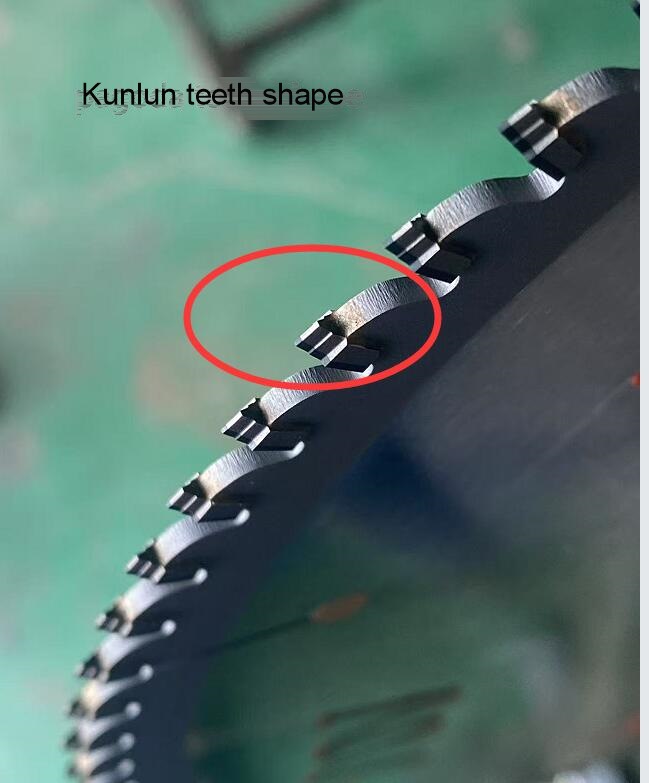
The Kunlun teeth shape is not a universal panel blade, and treating it as one is how buyers end up disappointed. It is specified for finished-face board where the cut edge is seen, banded or assembled without further finishing - and within that group, the panel type changes what the blade has to do. This guide walks through the panel families a furniture or panel plant normally cuts, explains what each one demands from the tooth profile and the body, and states where the profile stops being the right answer. It is for buyers matching one blade to a panel mix rather than ordering for a single material.
Melamine-faced chipboard and MDF
This is the core application. A melamine face is a thin, brittle decorative layer over a particle or fibre core, and it fails at the cut line by chipping: the resin layer breaks away from the core ahead of the tooth. The Kunlun profile counters that by supporting the material as the tooth enters, so the decorative layer is cut rather than lifted.
MDF behaves slightly differently. It is homogeneous and easy to cut cleanly, but it is abrasive and it produces fine dust that loads the tooth gullets. On MDF the limiting factor is often chip evacuation and heat rather than chipping, which is why the feed rate and the tooth count matter as much as the profile.
HPL and compact laminate
High-pressure laminate and compact board are dense, hard and unforgiving. The face does not tear so much as shatter at the exit, and a blade that is not running true will show it immediately on the underside. Two requirements follow: the profile has to control the exit as well as the entry, and the body has to hold the plate flat, because runout on dense laminate converts directly into edge damage.
Compact laminate also loads the blade thermally. Where the material is thick and the cut is closed, chip clearance and the risk of heat build-up deserve as much attention as the tooth geometry.
Veneered panels
Veneer is the most demanding face in this group because the decorative layer is thin, has a grain direction and is glued - so it can lift, splinter or tear depending on which way the tooth meets the grain. A stepped profile that supports the cut reduces the lift, but veneer also rewards a high tooth count and a stable body.
Expect to test veneered panels rather than to specify them from a table. Grain direction, glue type and veneer thickness vary enough that a blade which is perfect on one veneered board can be marginal on another.
Painted and lacquered boards
A painted face fails differently again: the coating is brittle and the failure is a fine crack or flake line rather than a chip. The cut itself may be clean while the coating around it is compromised. On these panels the exit face is the vulnerable one, which is the same argument that made scoring saws common in the first place.
This is the panel family where a single-blade process earns the most, because the alternative is scoring a finished surface that cannot be repaired afterwards.
Solid wood, acrylic and composites
Solid wood is a different problem: the material is anisotropic, the loads are higher, and the blade is being asked to do work that a panel blade was not designed for. Where a line cuts both panels and solid timber, expect two specifications rather than one compromise blade.
Acrylic and composite sheets can be cut cleanly with a PCD blade, but they are less forgiving of heat. Melted edges and stress crazing around the cut are process problems that a tooth profile alone will not solve; feed rate, cooling and support matter at least as much.
Matching one blade to a mixed panel mix
Most plants do not cut one material. The practical question is which panel dominates and which edges are visible.
If the bulk of the volume is melamine-faced board and the edges are banded, the specification follows the dominant material, and the rarer panels are tested against it.
If a meaningful share is double-sided and visible, the blade has to control both faces every time, and the specification must be built around that rather than around the average.
If veneer or painted board is more than occasional, plan a second blade. A single compromise specification usually produces two mediocre results instead of one good one.
If abrasive material such as MDF or cement-based board is in the mix, treat it as a separate tooling question: it wears the tip differently and it loads the blade differently.
Where the profile is not the answer
Reclaimed timber that may contain nails, staples or grit, rough sizing before machining, and any job where the blade is likely to be abused should stay on carbide or tool steel. Neither the profile nor the tip material is designed to survive impact, and the cost of one incident can exceed the saving from the whole switch.
Next step
Send the panel materials you cut, roughly what share of the work is double-sided, and the edge standard you have to hit, to ferrytk898@gmail.com or use the contact form on this site. ZHONGJIAN TECH manufactures PCD and carbide-tipped saw blades with the Kunlun teeth shape, and we will tell you which of your panels the profile suits, which need a separate specification, and which should stay on another blade altogether.