
Kunlun Teeth
Panel Edge Chipping, Burrs and Notch Tearing: Causes and Fixes
Three defects with three different mechanisms: how to tell which one you have, what the tooth profile can remove, and what it cannot fix whatever blade you buy.
Chipping, burrs and notch tearing are often discussed as one problem. They are three problems with three different mechanisms, and they point to different fixes. A plant that replaces the blade whenever an edge looks bad is treating a diagnosis as a purchase. This article separates the three defects, explains what causes each, sets out a six-step diagnosis that runs before any blade is ordered, and states plainly what a tooth profile can remove and what it cannot. It is for production engineers and quality staff who are seeing rejects at the edge and need to know whether the blade is responsible.
Three defects, three mechanisms
Chipping is material breaking away from the decorative face - a small, irregular loss of the surface layer at or near the trim line. Burrs are roughness or raised material on the core edge, often on the underside of the cut. Notch tearing is a ragged, wedge-shaped tear where the tooth leaves the material, usually at the start or end of the cut or where the feed stops.
The mechanisms differ. Chipping is a surface-layer failure driven by support at the cut line. Burrs come from material that is pushed rather than cut, which is a sharpness and feed question. Notch tearing is an exit-condition failure, which is about the geometry of the tooth as it leaves the panel.
Chipping on the decorative face
The decorative layer is thin and brittle, bonded to a core that is not. When the tooth enters, the layer can break ahead of the cutting edge instead of being severed, and the pieces leave with the chip. Contributing factors are a tooth that does not support the material at entry, a tooth count too low for the feed rate, a blade that is not running true, and a panel whose face is poorly bonded.
Where chipping appears on one face only, the mechanism is almost always the exit face, not the entry face. Where it appears on both, the support at the cut line is the place to look first.
Burrs on the core edge
Burrs are material displaced rather than removed. A tooth that is no longer sharp enough to sever the fibre pushes it, and the pushed material stands up as a burr on the core edge - most often on the underside, where support is weakest. Increase the feed, reduce the tooth count or continue with a worn blade and the burr gets worse.
This is also the defect most often mistaken for a profile problem. A sharp blade of the wrong profile will still cut cleaner on the core edge than a worn blade of the right one. Sharpness first, profile second.
Notch tearing at the exit
As the tooth leaves the panel it takes a chip with it, and if the material behind the tooth is unsupported the chip takes surface material along with it. The result is a notch - a tear at the point of exit that repeats at the same pitch as the teeth. On a stopped cut it appears exactly where the blade stopped.
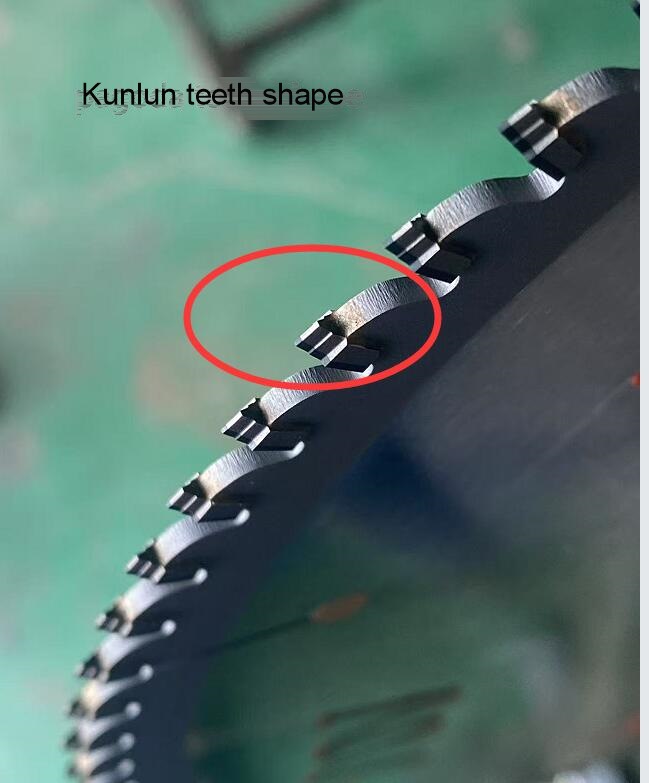
Exit support is the mechanism a stepped profile addresses directly. That is the specific defect the Kunlun teeth shape is designed around: the stepped geometry holds the material as the tooth leaves, so the chip separates cleanly instead of pulling the surface with it.
A six-step diagnosis before you buy a blade
1. Identify which face fails. Entry side, exit side or both. This single observation eliminates half the possible causes.
2. Measure runout and check the mounting. A blade that is not running true will chip regardless of profile. Check the flange, the bore fit and the spindle.
3. Record feed rate and spindle speed. Compare with what the tooth count was specified for. A blade run too slowly for its tooth count rubs; too fast, it overloads.
4. Inspect the blade for wear and damage. Look at the tips under magnification. A worn or chipped tip produces burr and tear that no adjustment will remove.
5. Check the panel. Face bonding, moisture and the age of the board all change how the surface behaves. A batch that chips where an earlier batch did not may be a material change, not a blade change.
6. Isolate one variable at a time. Change one thing, run the same panel, look at the same face. A change of blade, feed and support at once teaches nothing.
What the profile removes and what it does not
The profile addresses the defect caused by unsupported material at the cut line - which is chipping on finished faces and notch tearing at the exit. On a machine that runs true, with a feed rate the tooth count can support, it removes the need for a scoring saw on those defects.
It does not fix a worn tip, a bent flange, a spindle with runout, or a feed rate beyond what the blade can clear. It also does not make an unsuitable panel suitable: material with hard inclusions, reclaimed board and heavily contaminated surfaces will damage any blade. If the diagnosis above points at the machine or the material, changing the blade will move the defect rather than remove it.
Next step
If you can describe which face fails and send the machine model, the blade currently fitted, the feed rate and a photograph of the defect, that is enough for a useful answer. Send it to ferrytk898@gmail.com or use the contact form on this site. ZHONGJIAN TECH manufactures PCD and carbide-tipped saw blades with the Kunlun teeth shape, and we will tell you whether the profile is the fix for the defect you are seeing - or whether the problem sits upstream of the blade.