Technical Guides
Edgebander Pre-Milling Cutter Selection Guide: Z2+2 vs Z3+3, Sizes and LEUCO Cross-Reference
How to specify a PCD jointing cutter for an edgebander: the four dimensions that decide fit, Z2+2 versus Z3+3, which LEUCO part numbers cross to which machine, and when a cutter needs replacing.
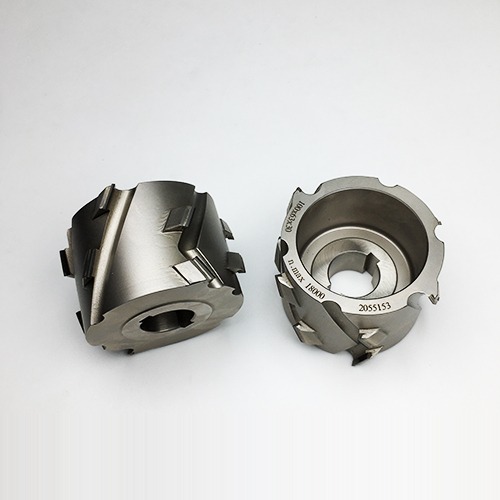
Every edgebander has a pre-milling station sitting directly in front of the glue pot. Its job sounds simple — trim the raw board edge square and clean before the banding goes on — but it is the station that decides whether the finished joint is invisible or whether you can see a dark glue line running down every panel.
This guide covers how to specify the cutter correctly: the dimensions that must match the machine, the Z2+2 versus Z3+3 decision, the LEUCO part numbers that cross to each machine brand, and the practical signs that a cutter has reached the end of its life.
What the pre-milling cutter actually does
The board arrives from the panel saw with a sawn or scored edge that is square within a tolerance but not clean. The pre-milling cutter removes a small amount of material from the top, bottom and edge of the board so the banding has a flat, burr-free, geometrically consistent surface to bond to.
Two things follow from that. First, the cut has to be chip-free on the panel faces, because the banding only covers the edge — not the face. Second, the cut has to be geometrically consistent along the whole length, because any variation in the pre-milled profile shows up as a glue line thickness variation downstream.
The four dimensions that decide whether it fits
Outer diameter, height, bore diameter and the Z layout. Those four values are printed on the cutter body and in the machine manual, and they are the only reliable basis for an order.
Outer diameter (commonly 85 mm, 100 mm) sets the cutting speed at a given spindle RPM and the clearance inside the machine guard. Height (34 mm, 45 mm, 48 mm, 63 mm) is set by the maximum panel thickness plus the banding, plus the machine geometry. Bore (usually 30 mm on European edgebanders) must match the spindle exactly, including any keyway.
The Z layout — 2+2 or 3+3 — is the number of cutting edges: two left plus two right, or three left plus three right.
Z2+2 versus Z3+3
Z2+2 has four cutting edges in total. It is the standard configuration on many machines and the more economical option. Z3+3 has six edges, which means a smaller chip load per edge at the same feed rate: less wear per metre, a smoother cut, and the ability to run faster.
The trade-off is price. On a machine running at moderate feed rates in standard melamine-faced chipboard, Z2+2 is entirely sufficient. On a high-speed line, or in abrasive MDF with a hard HPL face, the extra edges of a Z3+3 head pay for themselves in service life.
The machine decides this, not the buyer: the spindle, the feed rate range and the existing head all point to one configuration. Substituting a 2+2 for a 3+3 (or the reverse) changes the chip load and can shorten tool life or degrade the cut.
LEUCO cross-reference: which number fits which machine
Most European edgebanders were originally supplied with LEUCO tooling, and the LEUCO part number is the most reliable cross-reference. Our range covers these directly:
100 x 34 x 30 Z3+3 — LEUCO 181152 (right) / 181153 (left). IMA, Brandt.
100 x 48 x 30 Z3+3 — LEUCO 181154 / 181155. IMA, Brandt, SCM-IDM.
85 x 45 x 30 Z3+3 — LEUCO 181165 / 181166. OTT.
100 x 48 x 30 Z2+2 — LEUCO 181516 / 181517. HOLZ-HER, SCM.
100 x 63 x 30 Z2+2 — LEUCO 181518 / 181519. HOLZ-HER, SCM.
100 x 63 x 30 Z3+3 — LEUCO 182175 / 182176 (Brandt) and 182393 / 182392 (SCM).
We also supply cutters for Biesse, Homag, Felder, Hebrock, IMA and Bi-Matic machines, and for machines where the original tooling has been replaced by a non-standard head.
Left hand and right hand: why the direction matters
A pre-milling head cuts on one rotation direction only. Left-hand and right-hand heads are mirror images and are not interchangeable: a left-hand head on a right-hand spindle will not cut at all, and in some machines it will contact the guard.
The LEUCO numbering above lists right/left pairs for exactly this reason. When ordering, confirm both the size and the hand.
When a cutter needs replacing
A PCD jointing cutter does not usually fail suddenly. It wears at the corner where the tip meets the panel face, and the first symptom is a faint tear-out on the melamine or the HPL face at the start and end of the cut.
Left alone, that tear-out grows into visible chipping, then into a rough edge that the glue cannot cover. At that point the machine is producing scrap at full speed. The useful inspection is a visual check of the panel edge under a light every shift, plus a check of the cutter tips under magnification at each blade change.
Unlike a saw blade, a pre-milling cutter head is generally replaced rather than re-sharpened, because the tip geometry is complex and the cost of re-grinding six PCD tips approaches the cost of a new head.
Installation notes
Clean the spindle taper and the bore before mounting. Torque the retaining nut to the machine specification. Check that the head rotates freely by hand before running, and run the machine at low speed for the first panel to confirm the rotation direction and the clearance.
A head that is not seated flat will cut an uneven profile, which shows up as a wavy glue line on one side of the panel only — a useful diagnostic if the problem appears immediately after a tool change.
Frequently asked questions
Can I use a Z2+2 head where the machine had Z3+3? Physically yes if the dimensions match, but the chip load per edge doubles at the same feed rate, so tool life and finish will both suffer. Reduce the feed rate if you have no alternative.
Do PCD cutters need coolant? No. PCD runs dry in panel materials; coolant is not used on an edgebander pre-milling station and can affect the glue bond downstream.
How long does a PCD jointing cutter last? Measured in linear metres of board, not months: typically several hundred thousand metres in standard melamine chipboard, considerably less in HPL-faced MDF. Record the metres per head on your machine to build your own replacement interval.
What if the machine brand is not on the list? Send the bore, height, outer diameter and Z layout measured from the existing head, plus a photograph of the head on the spindle. That is enough to match it.
On an edgebander, the pre-milling cutter is a wear part whose service life is measured in metres of board — plan replacement by metres, not by intuition.
ZhongJian Tech manufactures PCD diamond jointing cutters, pre-milling cutter heads and edgebander replacement tooling in Futian Town, Anyuan District, Pingxiang City, Jiangxi Province, China. Send your machine brand and model, the panel material and the part number you are replacing, and we will confirm the specification and quotation. Email ferrytk803@gmail.com, phone / WhatsApp +86 13617995900.