Oct 4, 2026
Salt Spray Testing: Evaluating Corrosion Resistance for Blades
Salt spray testing ranks blade materials and finishes by corrosion resistance. Learn what the test proves, where its limits lie, and when to request it.
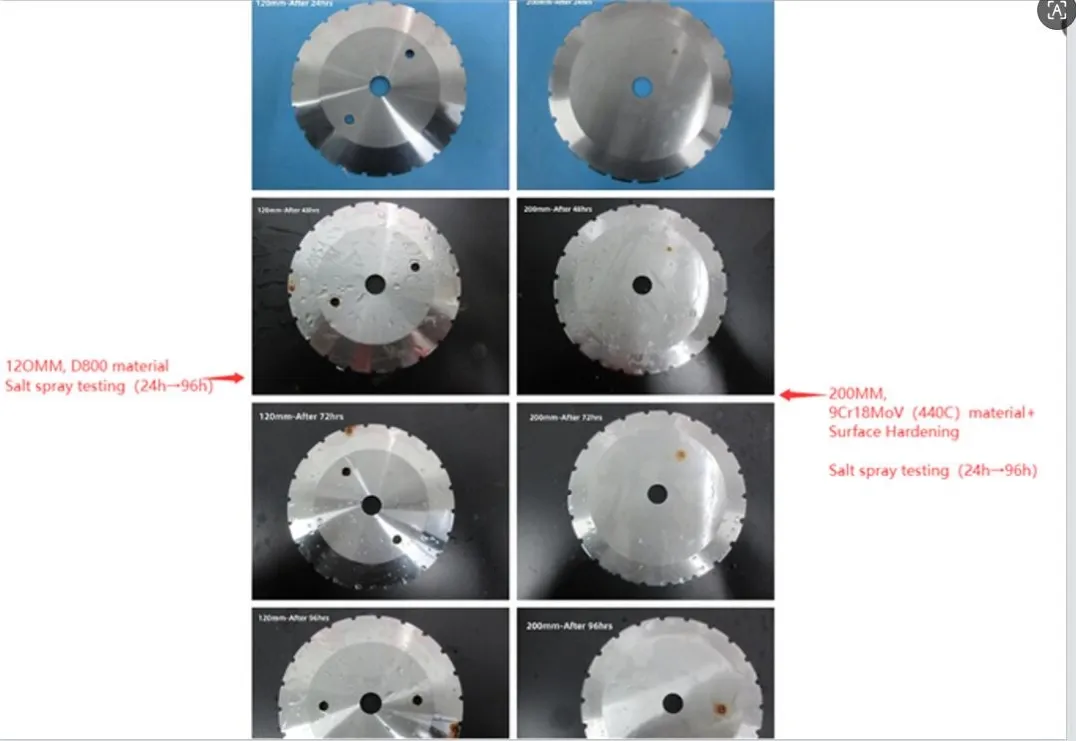
Cutting blades live in environments that eat steel: food processing washdowns, marine and coastal operations, humid storage and long sea freight. When a blade corrodes, it does not just look bad - edges pit, cutting performance drops, and hygiene risks rise. Salt spray testing is the standard tool the industry uses to compare how materials and surface treatments stand up to those conditions before a blade ever ships.
This guide explains what salt spray testing is, what its results do and do not prove, and when blade buyers should ask for test data.
What salt spray testing is
Salt spray testing - also called salt fog testing - exposes samples to a continuous mist of saline solution in a closed chamber, reproducing in concentrated form the moisture-and-salt conditions of coastal air, marine environments and aggressive industrial settings. Tests follow standardized procedures (ISO 9227 is the internationally referenced method) with a controlled salt concentration, temperature and mist density. Duration is chosen by the requirement: a screening test may run 24 to 96 hours, while demanding specifications run into the hundreds or thousands of hours. Results are read as the appearance and progression of corrosion - rust bloom, pitting, coating breakdown - over time.
What the results prove - and what they do not
Salt spray testing is best understood as a ranking tool. Run the same test on two materials, two surface finishes or two heat-treatment conditions, and the difference tells you which will resist corrosion better in service. It is a fair comparison because every sample faces identical conditions.
The limits matter just as much. A salt spray chamber accelerates corrosion but does not reproduce real service exactly: actual conditions include variable humidity, drying cycles, cleaning chemicals and mechanical wear, and those interactions change outcomes. A long test result does not translate directly into a service lifetime, and a short-duration result should not be over-interpreted. Used properly, the test separates good from better; used carelessly, it becomes a marketing number.
When blade buyers should ask for it
Three situations justify salt spray data. First, food processing - washdown chemicals and salty products make corrosion a hygiene issue, and test results support the material selection rationale. Second, humid, coastal or marine operations, where blades may sit idle in salt air between shifts. Third, shipping and storage: blades travel long distances by sea before they cut anything, and a finish that survives the journey intact says something about the manufacturer's process control. Where any of these apply, ask which materials and finishes were tested, under which standard, and for how long.
Corrosion resistance is a system, not a single test
Salt spray results should feed into a wider decision. Material grade sets the baseline - food-grade stainless steels resist corrosion far better than plain carbon steels. Surface finish matters next: polished and passivated surfaces present fewer initiation sites. Maintenance practice closes the loop: blades dried and stored properly between shifts outlast identical blades left wet. Testing confirms the material and finish choices; the operating discipline decides how much of that resistance is realized.
Requesting tested blades
ZHONGJIAN TECH produces industrial and food processing blades in stainless and tool steel grades, supports corrosion-resistance evaluation for reference, and supplies inspection records with production batches. Send your application conditions - products handled, cleaning regime, storage and shipping route - to ferrytk898@gmail.com and we will confirm suitable materials and documentation for your program.